We Forgot How to Be Efficient. Now the Planet Is Paying for It.
The race to build AI data centers is being sold as a national security imperative. But it's really a failure of imagination — and a repeat of a mistake programmers made decades ago.
There is a story programmers used to tell newcomers, half warning and half legend: in the early days of computing, you had 64 kilobytes of RAM and you were grateful for it. If your program didn't fit, you didn't ask for more hardware. You got creative. You rethought the algorithm. You shaved bytes from places no one else would think to look. Efficiency wasn't a best practice — it was survival.
Then hardware got cheap. Processing power doubled on schedule, storage became practically free, and the hard discipline of writing tight, efficient code quietly dissolved. Why optimize when you can scale? The culture shifted, and with it, an entire craft mentality was lost. Software got slower as hardware got faster — a phenomenon so consistent it earned its own name: Wirth's Law.
We are now watching the same story repeat itself at a civilizational scale, and the consequences are no longer just sluggish applications. They are blackouts, droughts, and carbon.
"The response to 'AI is expensive and power-hungry' has been almost entirely 'build more capacity' — not 'build smarter systems.'"
The data center arms race
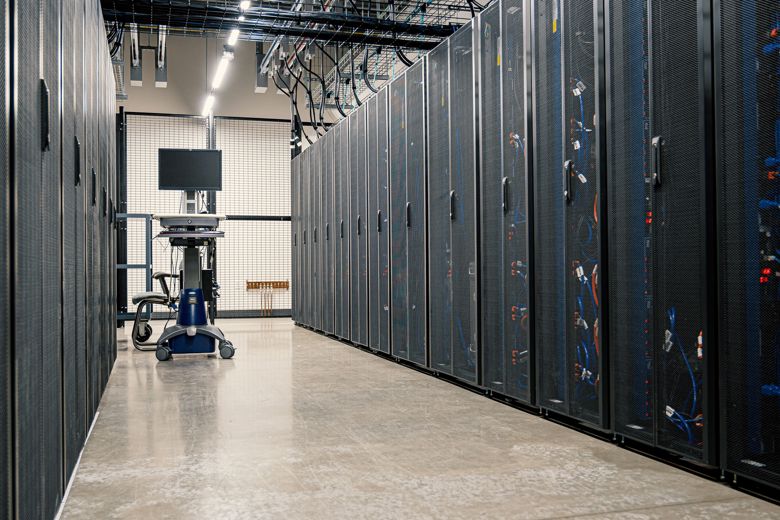
Major AI labs and their government backers are in the midst of an unprecedented buildout of data center infrastructure. The justification offered, almost reflexively, is geopolitical: China is building, therefore we must build faster and bigger. This framing is politically potent and technically convenient. It converts what should be an engineering and ethics question into a national security one — a category where efficiency arguments can be waved away as naive, or worse, unpatriotic.
But the physical costs are not hypothetical. AI data centers consume enormous quantities of electricity and fresh water for cooling. In drought-stressed regions, this is not an abstraction. Electrical grids are straining under the new load, and the energy mix powering these facilities is far from clean. The carbon footprint of training a single large language model has been compared to the lifetime emissions of several cars.
None of this is inevitable. It is a choice — a choice to solve a hard problem by throwing more resources at it rather than by thinking harder.
The efficiency tools already exist
What is maddening is that the efficiency work is being done. Quantization allows models to run with a fraction of their original memory footprint, often with minimal quality loss. Sparse attention mechanisms reduce the computational complexity of processing long sequences. Mixture-of-experts architectures route inputs to smaller specialized subnetworks rather than activating a full model for every token. Distillation compresses the knowledge of a massive model into a much smaller one.
These techniques work. Researchers and independent developers have demonstrated models that run on consumer hardware — laptops, smartphones, edge devices — at quality levels that would have required a data center just a few years ago. A quantized 7-billion-parameter model running locally on a mid-range machine is not a toy. For many applications, it is indistinguishable from its larger cloud-hosted cousins.
But the incentive structure of the AI industry does not reward this. A 10x more efficient model generates less press than a 10x larger one, even when the efficient model is more broadly useful and more ethically deployable. Prestige flows toward scale. Funding follows prestige.
"A 10x more efficient model generates less press than a 10x larger one — even when the smaller model is more useful to more people."
What we lost when we stopped caring about efficiency
The early programmers who squeezed applications into kilobytes weren't just conserving resources. They were developing a deep understanding of their systems — an intimacy with how computation actually worked that produced better software at every level. Constraints forced creativity. The demoscene, a subculture that still produces stunning real-time graphics in 64 kilobytes for sport, is a living museum of what that discipline could achieve.
When that constraint was lifted, something more than efficiency was lost. The craft mentality — the refusal to accept waste as a default — went with it. Modern codebases routinely spin up multiple layers of abstraction to avoid writing thirty lines of code that would run orders of magnitude faster and use a fraction of the memory. The hardware will handle it. Except now the hardware requires its own power plant, and the power plant has consequences.
This is not a call for nostalgia. Writing in assembly is not the answer. But the values that assembly programming enforced — think before you allocate, question every abstraction, understand what your code actually does — are not obsolete. They are more urgently needed than at any point since the mainframe era.
What a different path would look like
The alternative is not to abandon AI. The technology is genuinely transformative and the potential benefits are real. The alternative is to treat efficiency as a first-class engineering value rather than an afterthought for when budgets get tight.
This means funding and prestige flowing toward efficiency research with the same enthusiasm currently directed at scale. It means AI companies publishing not just benchmark scores but energy cost per inference. It means procurement decisions by governments and corporations that weight environmental impact alongside capability. It means developers, at every level of the stack, relearning the lesson their predecessors knew by necessity: the most elegant solution is usually the most efficient one.
It also means resisting the geopolitical framing that makes these conversations feel treasonous. The question of whether to build another gigawatt data center is not a question about whether America should remain technologically competitive. It is a question about whether we are solving the right problem. A nation that leads the world in AI efficiency — in doing more with less, in deploying capable models on the hardware people already own — is not losing the AI race. It is winning it on different terms.
The constraint is coming regardless
The uncomfortable truth is that we may not choose efficiency voluntarily. Power grids have physical limits. Water supplies are not infinite. The political and social tolerance for data centers that consume the resources of small cities will not expand indefinitely. In the early days of computing, the constraint was just physics — 64 kilobytes and that was that. Today's constraints exist but capital can paper over them, delaying the reckoning long enough to make it worse.
When the constraint arrives anyway — and it will — we will wish we had started the efficiency work earlier, when we had the luxury of choosing it rather than having it imposed. The programmers who learned to write tight code under necessity became the best engineers of their generation. We have the opportunity to learn that lesson before necessity forces it on us.
The question is whether we are wise enough to take it.
PKA Will Michaels is an independent web developer and the creator of FearlessCMS, an open-source CMS built on the principle that software should do more with less.